
Nazafarin Lotfi’s work is currently on view as part of TMA’s 4×4 exhibition. Lotfi is an interdisciplinary artist who combines drawing, painting, video and sculpture to explore the spatial and temporal connection of bodies to their environment. Lotfi was a 2020 recipient of Phoenix Art Museum’s Artist Grant, was recently the International Artist-in-Residence (January–March 2021) at Artpace in San Antonio, Texas, and has an upcoming solo exhibition at Regards in Chicago opening in September 2021. Her work will be featured at TMA through September 26, 2021.
**this conversation has been edited for clarity**
Jeremy Mikolajczak (TMA): In brief, can you tell us about your upbringing, how you came to be an artist, and what brought you to Tucson?
Nazafarin Lotfi: I was born and raised in Mashhad, Iran and left my hometown for college to study art at the University of Tehran. I basically never went back, except for short trips. My mom introduced me to art – it was her curiosity and passion for history and culture that brought art close to our home.
I did not have access to contemporary art where I lived, so I did not see a lot of art before college. Instead, I saw ancient and historical artifacts. My family visited many archeological sites that were not too far from my hometown. It was during these visits that I learned about material culture, making objects, and the idea of touch as a means of communication and expression. I came to art from a humanities perspective and the activities that I did in my formative years – like reading science fiction and taking an observational drawing class – are still the bedrock of my practice.
A couple of years after finishing undergrad at the University of Tehran, I got accepted into the graduate program at the School of the Art Institute of Chicago in the Painting and Drawing Department. I lived in Chicago for about ten years teaching, making art, and showing work. I moved to Tucson in 2017 because my partner got a teaching job at the University of Arizona.
JM: In our studio visits and conversations, I always enjoy our exchanges about the meaning, origins, and processes related to your work. Thinking about the many layers of your sculptures, paintings, and drawings, how would you introduce your work to TMA’s audience?
NL: I explore the interaction of the body with its environment. I call it the figure ground relationship, which I see as the interchangeable relationship between the human figure and its surrounding space. I move between organic sculptural forms that evoke the body, and geometric shapes that remind me of architectural spaces. I am interested in the construction of space, how it defines who we are, and how it helps us understand our place in the world.
My work is layered and I arrive at it from multiple routes. I combine personal experiences with mythical, theoretical, and historical research. There often is also a political underpinning. I try to find a poetic or conceptual lens in order to explore these ideas – using metaphor to activate meaning and build relationships with things in the world.
Having grown up in a place that is strikingly different from where I live now, this multi-perspective worldview is critical to my experience and a natural part of who I have become.
JM: Observation of landscape and place is an important aspect of your studio practice. You often use your hikes in the Sonoran Desert as inspiration for studying the natural landscape. You also find inspiration in abstract recording of light and shadows created by windows and doors in your domestic space. How do you approach observation, and do these two approaches to observation inform one another, or are they completely different?
NL: They do inform one another. I do not draw strict boundaries between things. In my creative practice everything is connected to everything else. I am intentional about noticing things and I build sensitivities to what is around me. It is my way of connecting to where I am, because I do not have a strong sense of place and belonging. Hiking in the desert taught me how unprepared I was to deal with open space, and that impacted the work I was making in the studio.
I follow shadows and the change of light, both indoor and outdoor, as a way of becoming in tune with the daily transition of time. For me, shadows are an abstraction from reality, and conceptually they are exciting territory that fit right in with my explorations of liminality and space.
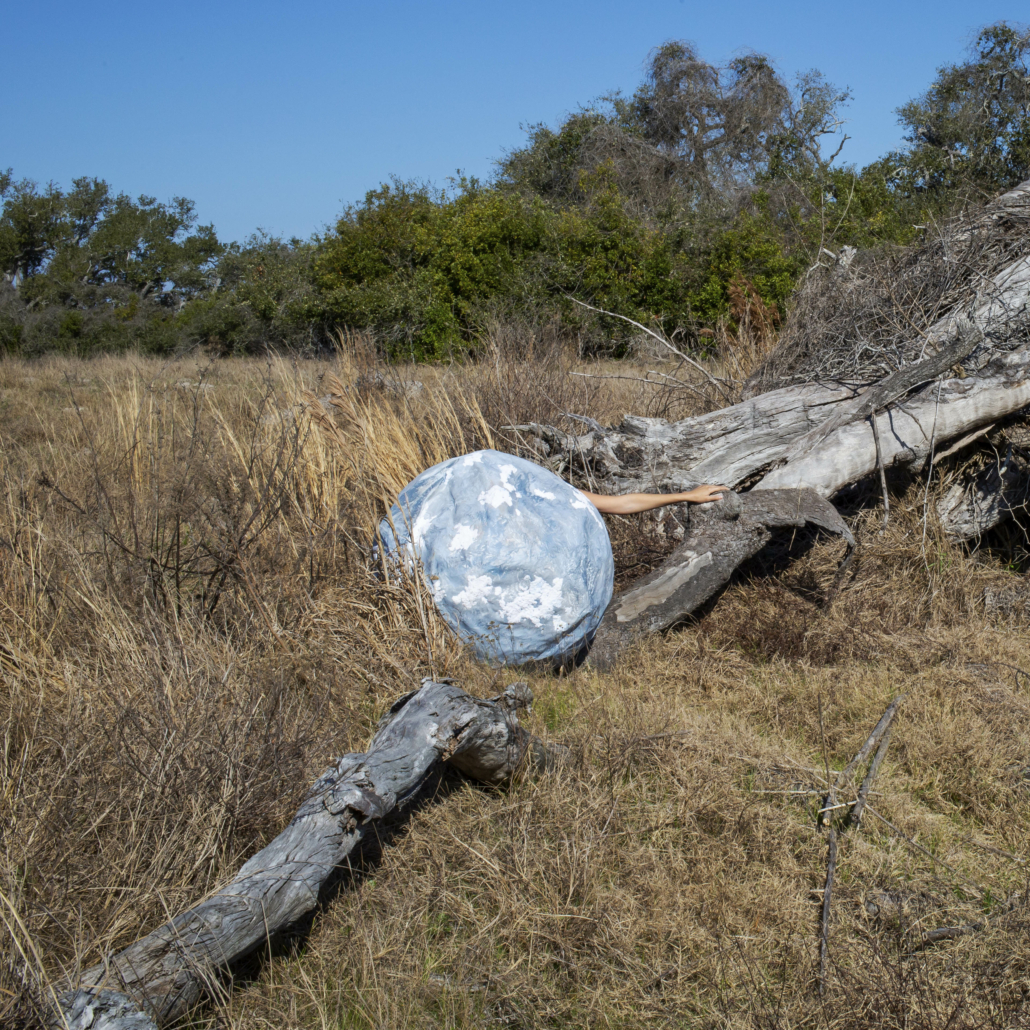
Nazafarin Lotfi, All Things that Grow, 2021, Commissioned by Artpace. Courtesy of the artist and Regards, Chicago.
JM: The papier-mâché sculptures started entering your work in 2014. They have often been presented in two different ways: formal sculptures in space or as a stand-in for implied interaction with you as the artist and urban and natural environments as in the project “Boulders.” Can you talk about the evolution of this process, how the forms are created, and your intentions in interacting with the works?
NL: Right, the papier-mâché forms ended up functioning in different ways. The ones that go outside are often simpler forms and are more interactive than the sculptures that stay indoors. Both bodies of work grew alongside each other and I have continued to work on both of them.
The Boulders that leave the studio are “social sculptures,” and are enclosed forms that interact with my body. I am interested in combining the animate (human body) and the in-animate (object) in order to create a hybrid form that is both the object and subject. In my recent photographic series, which will be on display at TMA, I incorporated my body and one of these sculptures at different natural pockets within an urban environment. My goal is to explore ways of inhabiting different places at once – proposing an existence between multiple worlds.
The other sculptures are formal explorations of the same ideas, without relying on my body or the natural/urban environment. I have created these objects to function as both the figure and the ground. These objects are hollow inside but are not enclosed. What you see is a shell that once contained something. We understand what is inside as the core (the figure), and what is surrounding it as its location, environment, or ground. So, the shells stand in as both the figure (in space) and the ground.
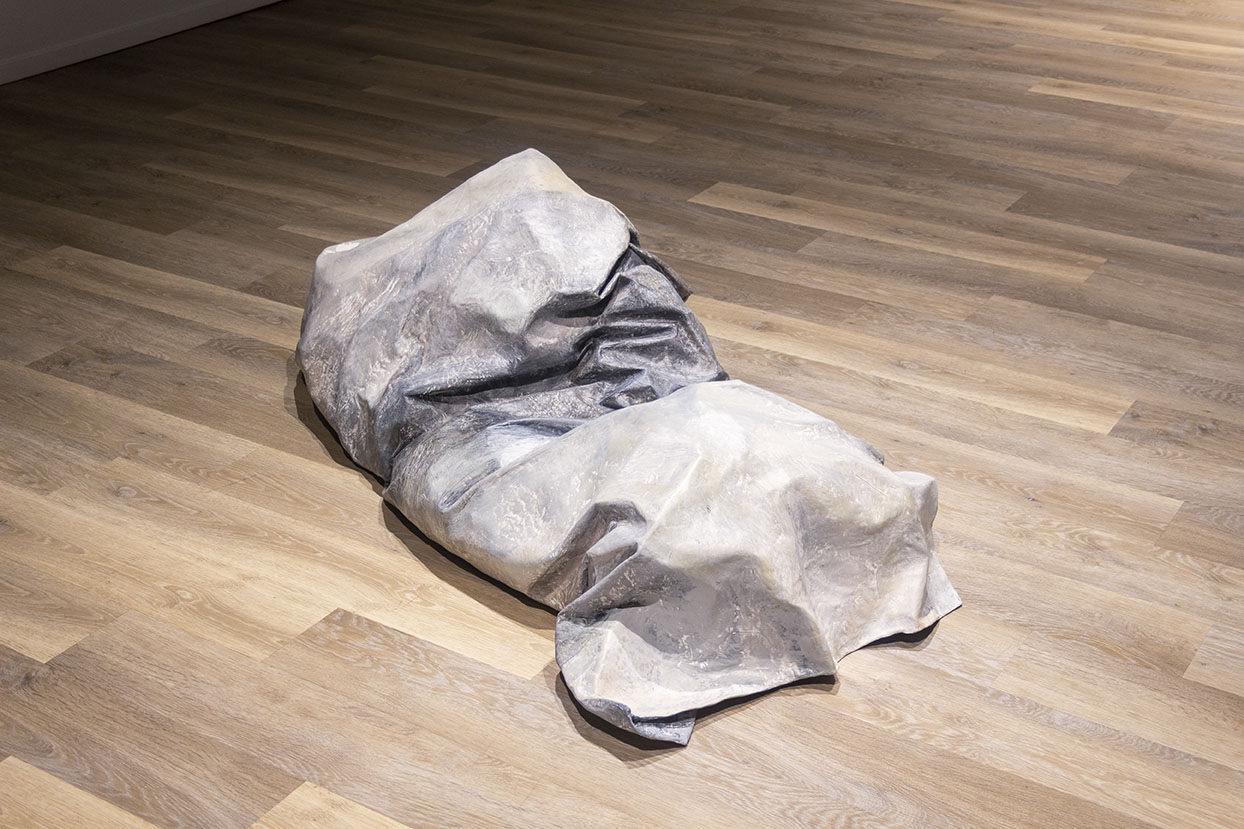
Installation view of Lotfi’s work in the 4×4 exhibition. Photo by Nathan Lothrop.
JM: Speaking about your interaction with the work, the relationship to the body / viewer is important. From the idea of the implied shroud to the spatial interaction between the work and audience, do you see this as a visual invitation for viewers to investigate the work?
NL: Absolutely. I always want that to come through and invite the viewers to participate in an act of exploration. The surfaces of my work, both drawings and sculptures, are textured and rich to invite the viewers to come up closer and look into the work.
The implied shroud or drapery that I use in some of the sculptural forms is a reference to a presence (or body) inside the object. Obviously, it is in conversation with the history of figurative object making (statues) too. I want the viewers to walk around the sculptures and look for openings or any other clue that can guide them to read the work.
JM: Shifting gears, you often mention critical texts that inform your creative practice. Would you share some of those texts and the writers that inspire you?
NL: A lot of thinkers and poets have inspired me over the years including: bell hooks, Franz Fanon, Albert Camus, Jorge Luis Borges, Sharhnoush Parsipur, Etel Adnan, Svetlana Boym, and many many more. I started reading Gloria Anzaldúa when I arrived in Southern Arizona and it was a really good way to familiarize myself with ideas of the borderland. She was a scholar and a cultural theorist that used the lenses of feminist and queer theory. Gloria grew up around the Texas-Mexico border and was able to theorize the cultural and social marginalization of her community in her critical writings. Her concept of Nepantla, which refers to an in-between place, is widely used by artists.
Another thinker that I have enjoyed in the past years is Sara Ahmed. Her book “Queer Phenomenology” has been particularly informative in my practice. I have also recently read texts by Donna Haraway and Sylvia Wynter, which were very influential in my thinking and visual work. I like to think about these writers in relationship to each other and put them in conversations in my research.
JM: Despite the pandemic, the past year has been productive for you as an artist. You debuted a new body of work at MOCA Tucson and participated in exhibitions in Illinois and elsewhere. How did you keep focused during 2020, and did the challenges help or hinder your process?
NL: There is no doubt that the pandemic year has been very difficult, and I am sure as time passes we will better understand the psychological and emotional damage that we all experienced. In many ways I feel very lucky about where I was in my life when the pandemic happened. My studio practice was not affected because I am not in a big, shared space and I do not take public transport to get to the studio. On another hand, I already knew the impact of separation from family and being banned from traveling. During this difficult time, I felt very lucky to have a creative practice that kept me engaged and active. The most important thing to me is to keep going and keep believing in the work.
Besides the pandemic, the current culture war and social justice uprisings have been on my mind. Like many other artists, I am always thinking about the role of art in the midst of everything. Last year was challenging on so many fronts, but it was also a good opportunity to evaluate our participation in the world that we are making and the future we want.
JM: From January – March 2021 you were an artist-in-residence at Artpace in San Antonio, how would you sum up your time there?
NL: Artpace is definitely one of the most interesting artist residencies that I have experienced. I got invited to participate in the spring residency on very short notice and had to come up with a proposal within a couple of weeks. In a matter of two months the initial proposal was researched, conceptualized, budgeted, and produced and I am very excited about the result. The short amount of time was stressful at times, especially because I usually take my time and engage with an idea for a while before acting on it.
It was amazing and rare to work for two months in the same space that would turn into the exhibition site. It allowed me to get to know the space before planning the show and think deeper about a site-responsive installation.
JM: For TMA, you create a new body of work informed by your exploration at Artpace. What will viewers experience and explore in this exhibition?
NL: For my solo show at TMA I have a selection from the photo series that I produced at Artpace called All Things that Grow. Alongside the photographs there are a number of floor sculptures that I have made specifically for this show. The work is a reflection on a year of loss. The exhibition offers new landscapes and proposes alternative modes of realizing the body in space.
JM: What is next for you and do you have big plans as we all re-enter the world in 2021?
NL: I traveled abroad in June/July to visit my parents in Iran, but plan to take some time to process the work I made and all that we went through over the past year.

